Stock Market Rebounds as Oil Prices Drop on Trump Remarks
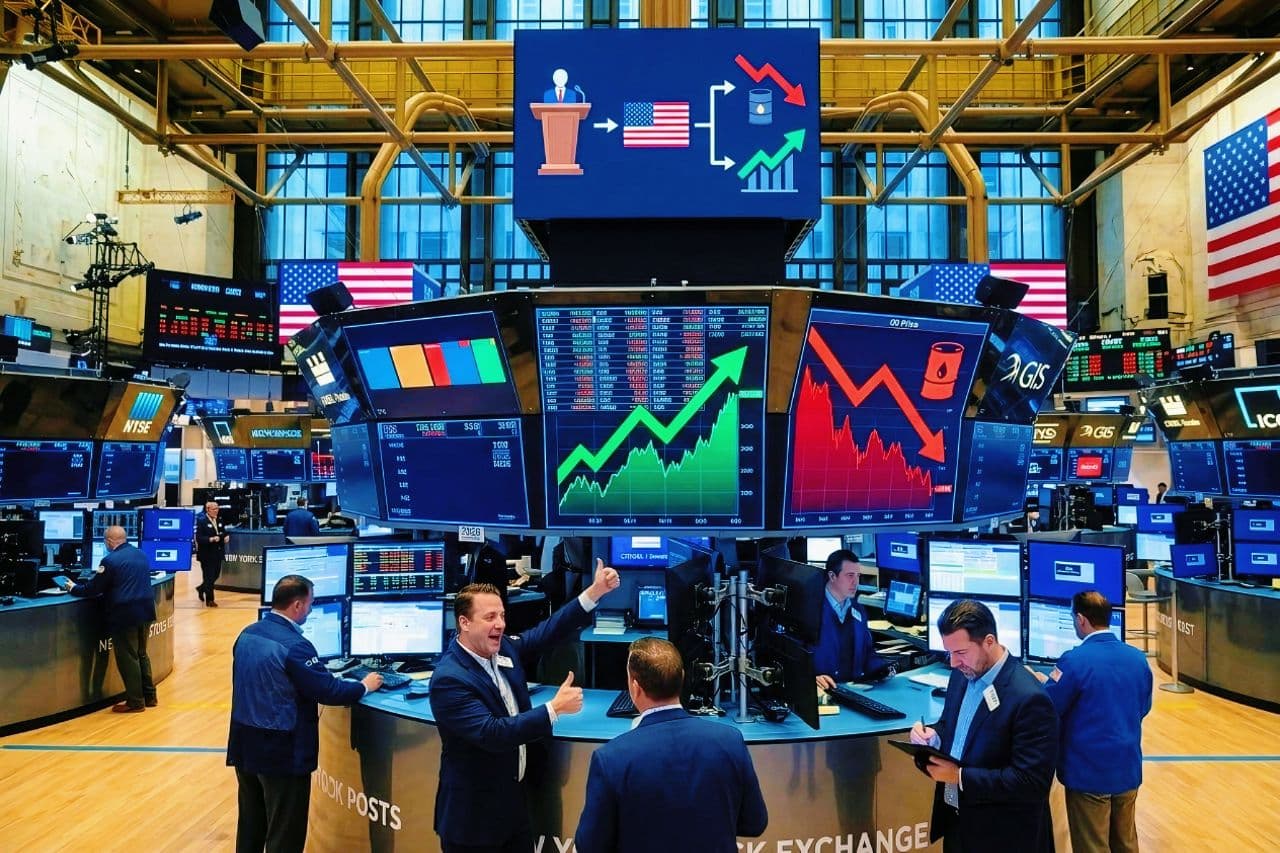
- Major U.S. indexes erased steep losses Monday and turned positive after oil prices retreated on comments from President Donald Trump. The Dow Jones, S&P 500, and Nasdaq all bounced back from early declines, reflecting investor relief as energy markets cooled.
- Oil futures, which had surged on geopolitical tensions, fell sharply following Trump’s remarks suggesting that prices would stabilize once the Iran conflict subsides. The drop in crude eased inflation concerns and gave equities room to recover, reversing the morning’s negative sentiment.
- Market analysts noted that the rebound highlights how sensitive equities remain to energy price swings. With oil still elevated compared to prewar levels, volatility is expected to persist as investors weigh geopolitical risks against corporate earnings.
- While Trump’s comments provided short-term relief, the outlook for stocks remains tied to the trajectory of oil prices and the duration of the Middle East conflict. Investors should brace for continued fluctuations across both energy and equity markets.
Key Takeaways
Stock Market Rebounds as Oil Prices Ease After Trump’s CBS Remarks
Major U.S. indexes turned positive in the final hour of trading Monday after President Donald Trump told CBS News that “the war is very complete, pretty much,” sending oil prices lower. The Nasdaq rose 1.3%, the S&P 500 gained 0.8%, and the Dow Jones climbed 0.5%, erasing a nearly 900-point decline earlier in the day.
Despite Monday’s rebound, stocks closed lower for a second straight week. The Dow fell 3% last week, its worst performance since April, while the S&P 500 dropped 2% and the Nasdaq slipped 1.2%. Oil futures surged as much as 35% last week their biggest weekly gain since 1983 as tanker traffic through the Strait of Hormuz halted amid U.S. and Israeli strikes on Iran. Futures briefly topped $119 a barrel before retreating to $88 after Trump’s comments and G7 signals of possible reserve releases.
Bank of America economists warned that oil prices above $100 could become concerning if sustained, raising inflation risks. Shares of airlines and cruise operators, which are highly sensitive to fuel costs, turned higher alongside tech giants after early declines. The 10-year Treasury yield eased to 4.10% from 4.13%, reflecting investor caution about stagflation risks as unemployment ticked up to 4.4%.
Elsewhere, the U.S. Dollar Index slipped slightly, gold futures fell 0.3%, silver advanced 3%, and Bitcoin rebounded to $69,200. Hims & Hers Health surged more than 40% after announcing a deal with Novo Nordisk to sell its weight-loss drugs, while Live Nation jumped 4.5% after settling with the DOJ without being forced to divest Ticketmaster.
Investors Face Rising Market Volatility Amid Iran War and Oil Price Surge
Stock-market jitters returned at the start of the week as U.S. crude surged past $100 per barrel, sending the Dow and S&P 500 lower. The Cboe Volatility Index briefly touched 30, a level signaling fear, while CNN’s Fear & Greed Index pointed to “extreme” fear. Despite these signals, many investors remain convinced that the disruption in U.S. stocks will be short-lived.
Analysts caution that investors may not be pricing in the possibility of deeper corrections or even a recession. Deutsche Bank researchers noted that repeated shocks over the past four years have conditioned investors to underreact to short-term disruptions. Equity positioning has dipped slightly below neutral, reflecting caution but not outright fear.
Prediction markets echo this sentiment. Polymarket bettors currently place a 74% probability on the S&P 500 ending the month above 6500, implying only a modest decline from recent levels. This suggests traders expect resilience despite geopolitical risks and energy market volatility.
The broader concern is whether investors are prepared for “more violent and frequent shocks” this year. With oil prices elevated, war in Iran ongoing, and stagflation risks rising, experts warn that complacency could leave markets vulnerable to sharper downturns than many anticipate.
Gas Prices Surge Nationwide as Iran War Fuels Oil Shock
Oil prices have spiked sharply as the Iran war disrupts supply routes, and the impact is hitting U.S. drivers fast. The national average for regular gas has jumped 50 cents in just eight days, climbing from $2.98 before the conflict to $3.48 today. Prices first broke above $3 on March 1 after holding below that level for 13 straight weeks, marking the longest stretch in the $2 range since 2021.
Since then, the average has risen daily as tensions in the Middle East escalate and crude markets rally. Gasoline prices, which closely track oil, are now surging across the country, squeezing household budgets and raising inflation risks.
State-level prices vary widely, with some regions still below $3 while others approach $5 per gallon. This disparity underscores how local supply chains and tax structures amplify the impact of global energy shocks.
The broader takeaway is clear: as long as oil markets remain volatile, U.S. consumers will continue to feel the squeeze at the pump. Economists warn that prolonged disruption could sustain higher fuel costs, adding pressure to inflation and weakening disposable income nationwide.
Oil Prices Hit Four-Year High as Iran War Raises Recession Fears
Oil prices surged Monday as the Iran war entered its second week, sparking concerns about its impact on consumers, markets, and the global economy. Brent crude and West Texas Intermediate futures briefly approached $120 a barrel overnight before retreating to around $100. Prices are now up about 40% since U.S. and Israeli strikes began late last month.
Iran has escalated tensions with missile and drone strikes on regional oil infrastructure and effectively shut down the Strait of Hormuz, a critical passage for one-fifth of the world’s oil and liquefied natural gas. Over the weekend, U.S. and Israeli forces also targeted energy assets inside Iran, intensifying fears of prolonged disruption.
Bank of America analysts warned that oil prices sustained above $100 could shave more than 60 basis points off U.S. GDP growth. They cautioned that inflationary pressures would weigh heavily on low-income households while tightening financial conditions for wealthier consumers who have been supporting the economy.
The broader risk is that persistent energy shocks could trigger stagflation high inflation paired with weak growth. Economists stress that the duration of the conflict will determine whether this surge fades quickly or evolves into a deeper recessionary threat.
Retirement Balances Surge in 2025 as Stock Market and AI Boom Drive Growth
Retirement savers saw significant gains last year as both the stock market and increased contributions boosted account balances. Fidelity’s analysis of tens of millions of IRA and 401(k) accounts showed the average 401(k) balance rose more than 11% between Q4 2024 and Q4 2025, while IRA balances climbed 7% over the same period.
The S&P 500 gained nearly 18% in 2025, fueled largely by strong growth in AI-driven stocks such as NVIDIA, Meta, and Alphabet. This rally not only lifted retirement portfolios but also encouraged savers to contribute more, amplifying the compounding effect of rising markets.
Financial advisors note that once clients experience the benefits of a rising market, they tend to be more motivated to continue funding retirement accounts. The combination of market performance and consistent contributions has created a powerful tailwind for long-term savers.
The broader takeaway is that retirement balances are highly sensitive to both market cycles and saver behavior. With AI stocks driving growth and investors motivated to contribute more, 2025 marked one of the strongest years for retirement savings in recent memory.
Iran War Escalates Stagflation Risks for U.S. Economy
War in the Middle East, surging oil prices, and a stagnant labor market are combining to create conditions reminiscent of the 1970s. The economic outlook worsened as U.S. and Israeli strikes on Iran continued, while Iran kept the Strait of Hormuz nearly closed, bottling up 20% of the world’s crude supply. With no signs of de-escalation, fears are mounting that prolonged disruption could drag on.
The prospect of a drawn-out conflict has raised the chances of stagflation high inflation paired with slow growth. Economists point to the last major bout of stagflation in the 1970s, when similar conditions caused energy prices to skyrocket and living standards to fall. Whether stagflation takes hold again depends largely on how long the current war persists.
Sal Guatieri, senior economist at BMO Capital Markets, warned that the U.S. now faces its “second stagflation-like shock inside a year.” Following the trade war, the Iran conflict is expected to lift inflation and bond yields, disrupt energy supply chains, rattle investor confidence, and weaken global demand.
The broader takeaway is that the U.S. economy is entering a period of heightened risk. If the war continues, stagflation could become the defining challenge of 2026, squeezing consumers, destabilizing markets, and undermining growth.
Financial Stocks Lead S&P 500 Declines Amid Market Weakness
Eight of the 11 industries tracked by the S&P 500 were in negative territory Monday morning, with financial shares leading the downturn. The S&P 500 Financials Sector dropped about 2.1% in recent trading, marking the steepest losses among major industries.
Other sectors also struggled, including Consumer Discretionary, which fell 1.7%, and Materials, down 1.5%. The weakness reflects broad investor caution as markets continue to react to energy price volatility and economic uncertainty.
Individual financial stocks were hit hardest. Franklin Resources slid 5.5%, Capital One Financial dropped 4.5%, and Huntington Bancshares fell 4%. These declines highlight the sector’s vulnerability to tightening financial conditions and investor risk aversion.
Overall, the benchmark S&P 500 index was down 0.6%, underscoring the pressure across equities as investors weigh stagflation risks, rising oil prices, and geopolitical tensions.
Hims & Hers Stock Surges on Novo Nordisk Weight-Loss Drug Deal
Hims & Hers Health shares soared nearly 37% Monday morning after announcing a partnership with Novo Nordisk to sell its weight-loss drugs, including Ozempic and Wegovy, on the telehealth platform. Novo Nordisk’s U.S.-listed shares also gained about 1% following the news.
The deal marks a major shift in the relationship between the two companies. Novo Nordisk had previously backed out of a partnership last year over concerns about Hims & Hers’ compounding practices. On Monday, the Danish drugmaker confirmed it will dismiss its lawsuit against Hims related to compounded medications.
Hims & Hers said Ozempic and Wegovy will be available through its platform later this month, expanding access to two of the most in-demand weight-loss treatments in the U.S. The announcement positions Hims & Hers as a stronger player in the telehealth and weight-management space.
The broader market reaction highlights investor enthusiasm for companies tied to the booming weight-loss drug sector. With demand for GLP-1 treatments surging, the partnership could significantly boost Hims & Hers’ growth trajectory while strengthening Novo Nordisk’s distribution reach.
Homebuyers Turn to Adjustable-Rate Mortgages Amid High Interest Rates
Mortgage rates have remained above 6% for three years, pushing many buyers toward adjustable-rate mortgages (ARMs) a loan type tied to the 2008 housing crisis. ARMs offer lower fixed introductory rates that later adjust to reflect market conditions, making them attractive in today’s high-rate environment.
While these loans carry the risk of higher monthly payments if rates climb, industry officials emphasize that stronger lending standards are reducing the dangers compared to the pre-crisis era. Buyers today face stricter qualification requirements, which helps minimize exposure to sudden payment shocks.
Phil Crescenzo Jr., vice president of Nation One Mortgage Corporation, noted that “in the current timeline, these buyers still are at minimal to low risk.” His comments reflect broader confidence that ARMs can be a practical option for borrowers navigating elevated interest rates.
The trend underscores how persistent rate pressure is reshaping buyer behavior. With affordability stretched, ARMs are re-emerging as a tool for households seeking relief, though the long-term risks remain tied to future rate movements.
Vertiv, EchoStar, Lumentum Gain on S&P 500 Inclusion; Coherent Slips
Coherent shares, which surged last week on Nvidia’s $2 billion investment, failed to rally Monday despite news it will join the S&P 500. The company’s stock slipped about 0.5% before the bell, contrasting with gains in other newly added firms.
S&P Dow Jones Indices announced Friday that Coherent, Vertiv, EchoStar, and Lumentum all benefiting from AI-driven investments will be included in the benchmark index before markets open on March 23. The move reflects growing investor demand for companies tied to advanced technologies.
Vertiv, EchoStar, and Lumentum shares each rose roughly 3% in early trading, highlighting investor enthusiasm for their inclusion. These gains underscore how S&P 500 membership often boosts visibility and attracts institutional capital.
The additions will replace Match Group, Molina Healthcare, Lamb Weston Holdings, and Paycom Software, which will shift to the S&P SmallCap 600. The reshuffle signals a broader market rotation toward firms positioned to benefit from AI and next-generation infrastructure.
Markets Brace for Inflation, Housing Data and Big Tech Earnings
Inflation will dominate investor focus this week as two major price reports arrive just ahead of the Federal Reserve’s next interest rate decision. These updates will provide fresh insight into the cost of living at a time when central bankers are debating whether to cut borrowing costs further. Housing data, including existing-home sales, will also be closely watched as economists look for signs of improvement in a sluggish market.
Oracle is set to report quarterly results after the bell on Wednesday, with investors eyeing momentum in AI and enterprise software. Hewlett Packard Enterprise and Adobe will also deliver earnings, offering a broader look at the technology sector’s strength. These reports come as investors weigh how AI-driven growth is shaping corporate performance.
Retail earnings will add another layer of market insight. Dollar General leads a lineup of consumer-focused companies reporting this week, providing a snapshot of household spending trends. Meanwhile, Tesla’s Chinese EV competitors are scheduled to release results, highlighting global competition in the electric vehicle market.
The broader takeaway is that this week’s mix of economic data and corporate earnings will set the tone for markets ahead of the Fed’s decision. With inflation, housing, and consumer sentiment in focus, alongside key tech and retail earnings, investors face a pivotal stretch that could shape expectations for the months ahead.
Live Nation Stock Jumps on DOJ Settlement Talks Over Ticketmaster
Live Nation Entertainment shares surged 9% before the bell Monday after reports suggested the company is nearing a settlement with the U.S. Department of Justice that would not require divesting Ticketmaster. Bloomberg, citing sources familiar with the matter, said settlement discussions have intensified since the trial began on March 2, with a final agreement potentially days away.
The DOJ filed an antitrust lawsuit in 2024 accusing Live Nation of monopolizing the concert ticketing and promotion market, seeking to force the company to sell Ticketmaster. Live Nation denied the allegations, and investors are now cheering the possibility of a resolution that allows the company to retain its ticketing unit.
Shares of Live Nation entered Monday up about 10% year-to-date, and the latest rally underscores investor optimism that the settlement will remove a major overhang. The outcome could reshape the competitive landscape in live entertainment while preserving Live Nation’s dominant position in ticketing.
The broader takeaway is that a favorable settlement would strengthen Live Nation’s growth outlook, reassure shareholders, and stabilize its market standing at a time when regulatory scrutiny has weighed heavily on the stock.
The Bottom Line
Major indexes erased steep losses Monday and turned positive after President Donald Trump told CBS News that “the war is very complete, pretty much,” sending oil prices lower. The Nasdaq rose 1.3%, the S&P 500 gained 0.8%, and the Dow Jones climbed 0.5%, recovering from a nearly 900-point decline earlier in the day.
Despite the rebound, stocks closed lower for a second straight week. The Dow dropped 3% last week, its worst performance since April, while the S&P 500 fell 2% and the Nasdaq slipped 1.2%. Oil futures surged as much as 35% last week their biggest weekly gain since 1983 as tanker traffic through the Strait of Hormuz halted amid U.S. and Israeli strikes on Iran. Futures briefly topped $119 a barrel before retreating to $88 after Trump’s comments and G7 signals of possible reserve releases.
Bank of America economists warned that oil prices sustained above $100 could raise inflation risks if persistent. Shares of airlines and cruise operators, which are highly sensitive to fuel costs, turned higher alongside major tech stocks after early declines. The 10-year Treasury yield eased to 4.10% from 4.13%, reflecting investor caution about stagflation as unemployment ticked up to 4.4%.
Elsewhere, the U.S. Dollar Index slipped slightly, gold futures fell 0.3%, silver advanced 3%, and Bitcoin rebounded to $69,200. Hims & Hers Health surged more than 40% after announcing a deal with Novo Nordisk to sell its weight-loss drugs, while Live Nation jumped 4.5% after settling with the DOJ without being forced to divest Ticketmaster.
Related Articles

Nvidia Projects $1 Trillion Chip Sales – AI Stocks Poised for Growth
Stock Market Closes Lower as Oil Prices Surge Despite IEA Release
Oracle Earnings Boost Stock but AI Market Momentum Stalls
Stock Market Update: Indexes Slip as Iran Conflict Fuels Volatility
Nvidia-Backed Stocks Enter S&P 500: Growth Opportunity This Month

Stock Market Retreats as Jobs Report Shocks
Iran Conflict Sparks Market Volatility, Stocks Rebound From Early Lows
Jamie Dimon Warns of Cyberattack Risks Amid Iran Conflict

Wall Street’s Calm Response to Iran War: Stocks and Oil Outlook
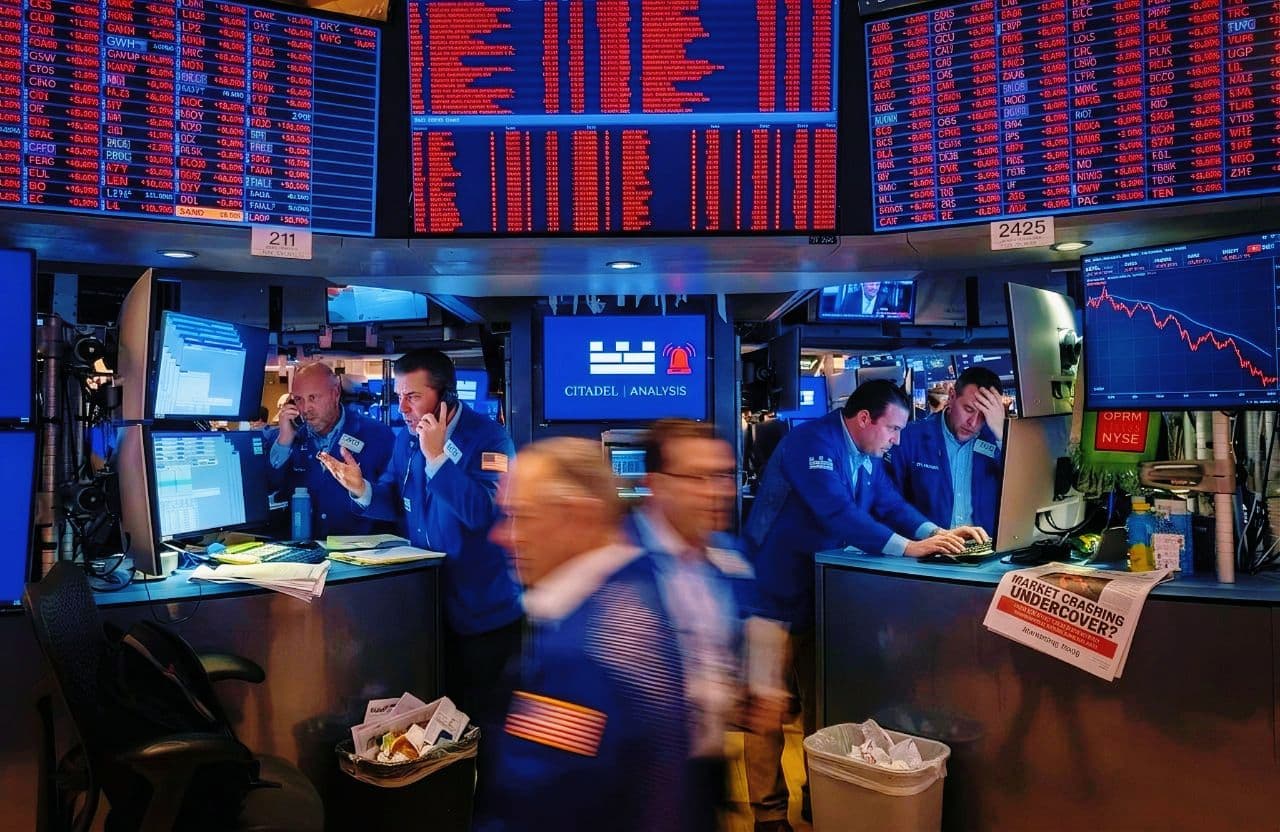
S&P 500 Stealth Correction: Expert Warns Market Has Crashed Beneath the Surface

Berkshire Hathaway Leadership 2026: Greg Abel’s Vision After Warren Buffett