Nvidia Projects $1 Trillion Chip Sales – AI Stocks Poised for Growth
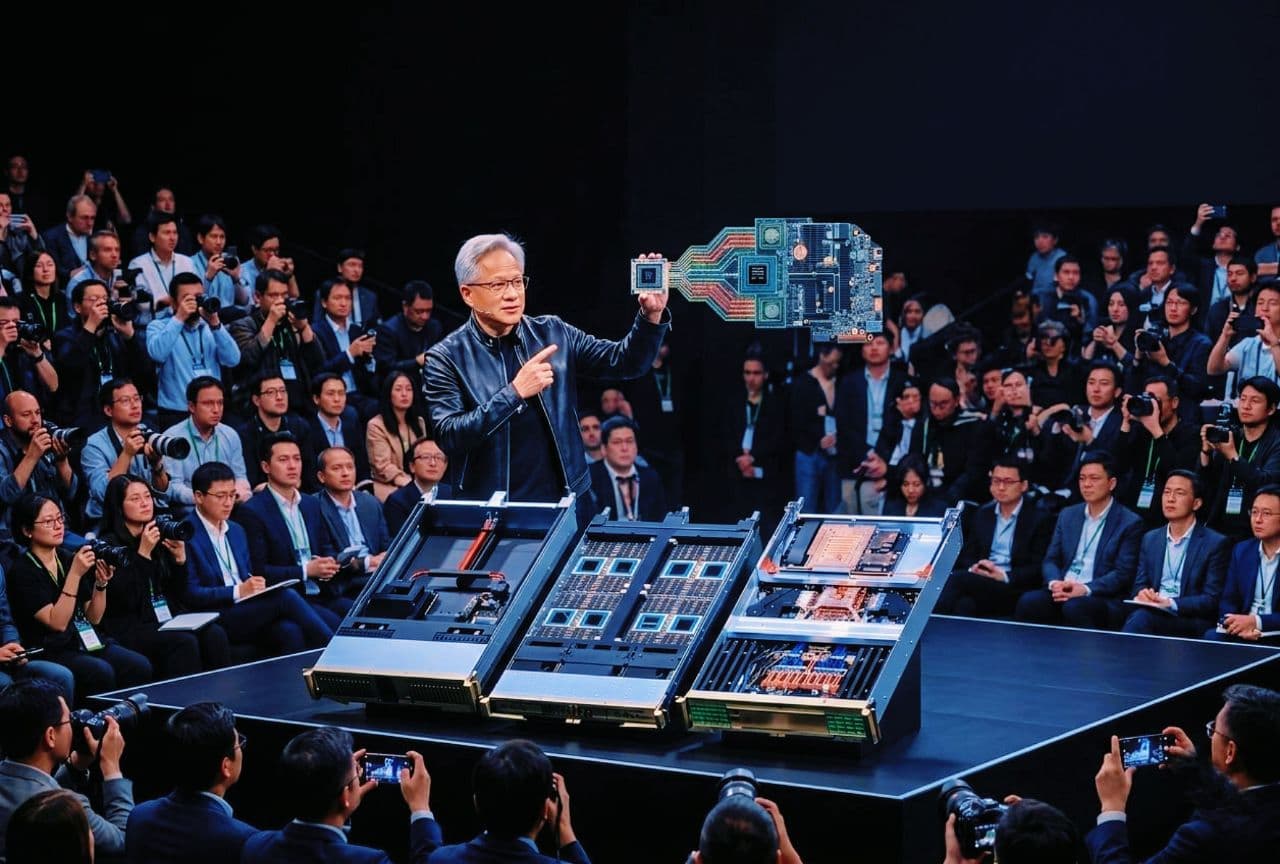
- Nvidia CEO Jensen Huang has projected more than $1 trillion in data center chip sales over the next two years, a forecast that analysts say could spark growth across the AI supply chain. This blowout projection highlights the scale of demand for advanced semiconductors as artificial intelligence continues to reshape industries from cloud computing to automation.
- On Tuesday, tech stocks delivered mixed performances. Some companies rallied on optimism tied to AI prospects, while others including Nvidia faced pressure as war-weary investors weighed geopolitical risks against long-term growth potential. The divergence underscores how investor sentiment is being shaped by both technological innovation and global uncertainty.
- For the broader market, Huang’s trillion-dollar forecast signals that AI infrastructure spending is set to accelerate. Companies positioned within the semiconductor and AI ecosystem could benefit significantly, though volatility remains a factor as investors balance macroeconomic risks with the promise of future expansion.
- Nvidia’s outlook reinforces the central role of chips in powering the AI revolution. While short-term market swings may temper enthusiasm, the trillion-dollar forecast provides a strong case for sustained investment in AI-related stocks as the sector continues to expand.
Key Takeaways
Nvidia CEO Forecasts $1 Trillion Chip Boom – AI Stocks Surge Back Into Spotlight
AI has returned to the center of Wall Street’s attention, even as investors juggle concerns about the war in Iran and the Federal Reserve’s policy meeting in Washington. The catalyst was Nvidia (NVDA) CEO Jensen Huang, who reignited excitement by forecasting no end in sight to the data center boom.
At an event Monday, Huang projected that sales of Nvidia’s Vera Rubin and Blackwell systems would exceed $1 trillion over the next two years. This marks a dramatic upgrade from the company’s earlier forecast of $500 billion across 2025 and 2026. Huang emphasized that demand for Nvidia’s hardware and software is “off the charts,” underscoring the scale of AI adoption across industries.
Wedbush analyst Dan Ives, a longtime Nvidia bull, described Huang’s outlook as “a much needed confidence boost for tech investors navigating a very tricky tape.” He added that the forecast signals the “AI Revolution is accelerating, not decelerating, despite the market noise.” This sentiment highlights how Nvidia’s leadership continues to shape investor confidence in the broader AI sector.
Nvidia’s trillion-dollar forecast has reignited momentum for AI stocks, positioning semiconductors and data center infrastructure as critical drivers of future growth. While geopolitical risks and monetary policy uncertainty remain, Huang’s bold outlook reinforces the narrative that AI is not just a trend it’s a structural shift in global markets.
Nvidia CEO’s $1 Trillion Forecast Revives AI Market Hopes
The AI infrastructure buildout has recently been overshadowed by economic uncertainty tied to the war in Iran. Nvidia CEO Jensen Huang’s keynote speech at the company’s annual product launch on Monday reignited some enthusiasm on Wall Street, reminding investors of the scale of opportunity in artificial intelligence.
Huang’s forecast of more than $1 trillion in chip sales over the next two years was a bold upgrade from earlier projections, signaling that demand for Nvidia’s systems remains exceptionally strong. His comments provided a spark of optimism for investors who have been navigating a volatile market environment.
Still, the speech wasn’t enough to trigger the kind of broad and sharp AI rally seen in past years. Investor caution remains elevated, with geopolitical risks and monetary policy uncertainty weighing heavily on sentiment. The muted reaction reflects how even groundbreaking forecasts can be tempered by global instability.
Nvidia’s trillion-dollar outlook underscores the long-term strength of AI infrastructure, but near-term market enthusiasm is being held back by external pressures. For investors, this means balancing optimism about AI’s growth trajectory with vigilance toward macroeconomic risks.
Nvidia’s $1 Trillion Forecast Fuels AI Market Debate
The once-booming AI trade is now caught between two seemingly contradictory concerns. On one hand, skeptics argue that AI may be overhyped, with tech giants spending hundreds of billions annually on infrastructure that they may struggle to monetize. On the other hand, optimists warn that we may be underestimating AI’s disruptive potential, with the technology poised to decimate entire industries. This tension has left investors questioning whether AI is a bubble or a revolution.
Momentum in the sector has been further dented this month by Wall Street’s fixation on the Middle East conflict, now entering its third week. Iran’s near-complete closure of the Strait of Hormuz has disrupted global oil supply, sending fuel prices soaring. Investors worry that the war will accelerate inflation and drag on global economies, derailing what was supposed to be a “goldilocks” year of strong growth, slowing inflation, and interest rate cuts.
Against this backdrop, Nvidia CEO Jensen Huang’s bullish comments on Monday offered a much-needed confidence boost. His forecast of more than $1 trillion in chip sales over the next two years signals unprecedented demand for AI infrastructure. Analysts believe this outlook bodes well not only for Nvidia but also for companies across the AI supply chain, from hyperscalers to cybersecurity firms.
Wedbush analyst Dan Ives highlighted the multiplier effect of Nvidia’s chips, estimating that every $1 spent on Nvidia hardware could generate $8 to $10 across the broader ecosystem. This projection reinforces the idea that AI is not just a technological trend but a structural shift with ripple effects across industries. For investors, the trillion-dollar forecast may be the clearest sign yet that the AI revolution is accelerating despite geopolitical and economic headwinds.
Nvidia’s $1 Trillion Forecast Highlights AI Supply Chain Winners
Bank of America analysts argue that Nvidia’s blowout forecast signals surging demand for computing power, with ripple effects across the AI supply chain. Beneficiaries include server makers like Dell (DELL), Super Micro Computer (SMCI), and Hewlett Packard Enterprise (HPE); data storage providers such as Sandisk (SNDK); and fiber optics suppliers Corning (GLW) and Amphenol (APH). This broad ecosystem stands to gain as Nvidia’s trillion-dollar outlook reshapes expectations for infrastructure spending.
Despite the bullish signals, AI stocks were mixed on Tuesday. Nvidia and competitor Advanced Micro Devices (AMD) closed marginally lower, while Broadcom (AVGO) slipped about 1%. Dell, Corning, and Amphenol also fell more than 1%, reflecting investor caution even in the face of strong long-term forecasts.
Not all sectors struggled. Shares of Uber (UBER) and Lyft (LYFT) rose after Nvidia announced expanded autonomous vehicle partnerships with the ride-hailing companies. Memory firms Western Digital (WDC), Seagate Technology (STX), and Micron (MU) jumped more than 4%, while chip manufacturing equipment suppliers Applied Materials (AMAT) and Lam Research (LRCX) also posted gains.
Nvidia’s trillion-dollar forecast is reshaping investor expectations, but market reactions remain uneven. While some AI-linked stocks surged on optimism, others slipped under pressure from broader market uncertainty. This divergence highlights both the opportunities and risks in betting on the AI revolution.
The Bottom Line
Nvidia’s $1 trillion forecast has reignited Wall Street’s focus on artificial intelligence, signaling massive demand for computing power and ripple effects across the AI supply chain. Server makers, storage providers, optics suppliers, and chip equipment manufacturers all stand to benefit from this surge, highlighting how deeply Nvidia’s outlook ties into broader infrastructure growth.
Despite the bullish signals, AI stocks delivered mixed results. Nvidia, AMD, and Broadcom slipped, while companies like Uber, Lyft, and memory firms Western Digital, Seagate, and Micron rallied. This divergence reflects investor caution amid geopolitical uncertainty, even as select sectors continue to ride the AI wave.
The forecast also underscores the multiplier effect of Nvidia’s chips, with analysts estimating that every $1 spent on Nvidia hardware could generate $8 to $10 across the ecosystem. This projection reinforces the idea that AI is not just a technological trend but a structural shift with far-reaching economic implications.
Ultimately, the bottom line is clear: Nvidia’s trillion-dollar forecast strengthens the case for long-term AI investment, but short-term volatility remains. Investors must balance optimism about AI’s transformative potential with vigilance toward global risks and market instability.
Related Articles

Stock Market Closes Lower as Oil Prices Surge Despite IEA Release

Oracle Earnings Boost Stock but AI Market Momentum Stalls

Stock Market Update: Indexes Slip as Iran Conflict Fuels Volatility
Stock Market Rebounds as Oil Prices Drop on Trump Remarks
Nvidia-Backed Stocks Enter S&P 500: Growth Opportunity This Month

Stock Market Retreats as Jobs Report Shocks

Iran Conflict Sparks Market Volatility, Stocks Rebound From Early Lows

Jamie Dimon Warns of Cyberattack Risks Amid Iran Conflict

Wall Street’s Calm Response to Iran War: Stocks and Oil Outlook

S&P 500 Stealth Correction: Expert Warns Market Has Crashed Beneath the Surface

Berkshire Hathaway Leadership 2026: Greg Abel’s Vision After Warren Buffett